A First Visit to a Local Public Meeting
A first visit to a local public meeting is easier when you know its purpose, prepare a few questions and listen for how discussion becomes a decision.
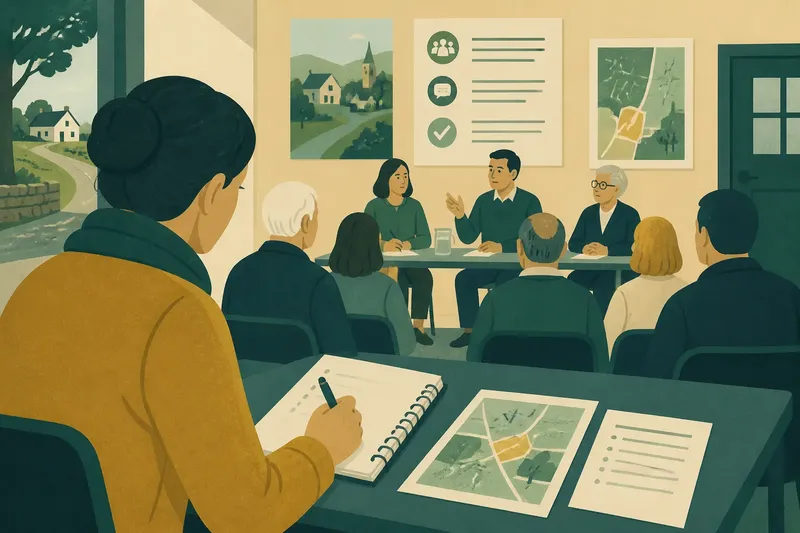
A first visit to a local public meeting can feel like arriving halfway through a conversation whose earlier chapters are kept in a folder. Start with the notice, take a few questions on paper and listen for what the meeting is actually being asked to decide. You do not need to understand every local custom before you walk in.
The aim is not to speak for the whole village or deliver a polished speech. It is to understand the subject, the process and the point at which residents can contribute. These preparations help you do that without turning an ordinary evening into an examination.
1. What is this meeting for?
Find the meeting notice, agenda or public papers before you set out. Depending on the place, the meeting may be organised by a parish or town council, a community association, a school body or another local institution. Those bodies do not all have the same responsibilities, so the name of the meeting alone may not tell you what it can decide.
Look for the stated purpose and the agenda item that prompted your interest. Is the group discussing a proposal, hearing views, receiving an update or making a formal decision? A meeting can include several kinds of business in the same evening. The item that matters to you may be one part of a longer agenda, rather than the main event.
Check whether the papers include a report, map, draft policy or set of options. Read the material that relates to the item, but do not assume you must master every attachment. Mark unfamiliar names or terms so you can ask what they mean if they become relevant. An agenda is a route map, not a promise that every discussion will follow a perfectly straight road.
If the notice gives little detail, contact the clerk, organiser or named public contact with a concise question: what is the meeting expected to consider, and is public comment invited? This is a request for orientation, not special treatment. Where an answer depends on the meeting’s rules or local procedures, check the published information or ask the organiser rather than guessing.
2. What should you bring?
Bring the agenda, any papers you have read and a notebook or phone for brief notes. If you want to refer to a particular paragraph, write down its page or heading. That small bit of preparation makes a question easier to follow and saves everyone from watching you search through a thick bundle while the room waits politely.
Write down the questions you genuinely need answered. Three clear prompts are often more useful than a page of grievances assembled in haste. You might want to know:
- What is the group being asked to decide at this meeting?
- Which alternatives are still open for consideration?
- What information or public feedback will inform the decision?
- Who is responsible for the next action, and when will an update be available?
These questions focus on the matter before the meeting and how it will proceed. If your concern is personal or involves confidential details, ask whether there is a suitable way to raise it outside the public discussion. A public meeting is not always the right place to put another person’s circumstances on the record.
Dress for the room and the journey, not for a ceremonial performance. A meeting in a village hall may be reached by a dark lane, and a room that seems warm at the door can become chilly when you sit still. Check the venue, parking or transport information, access arrangements and any joining instructions. Local life does not suspend weather or timetables for the agenda.
3. How can you follow the discussion?
Listen for the difference between information, opinion and a proposal. A speaker may describe what has happened, argue for a preferred option or ask the group to take a specific action. These can sound similar in conversation, but they lead to different next steps. Note the wording when the chair or organiser clarifies what is under discussion.
Pay attention to who has responsibility for the decision. A local group may be able to make a choice itself, recommend an option to another authority or simply record residents’ views. If the limits are unclear, ask which body will make the final decision and what remains within the local group’s control. It is easier to judge the discussion fairly once you know where its authority begins and ends.
Listen for the path from discussion to decision. Does the chair invite comments, summarise the options, propose a motion, ask for a vote or defer the matter for more information? Those are distinct stages. A firm exchange of views does not necessarily mean a decision has been made; equally, a quiet moment may precede a formal resolution.
Think of the agenda as a shopping list on the kitchen counter: it tells you what is meant to be dealt with, but it does not tell you who will pick each item up or what to do if something is missing. The chair, clerk or organiser can often clarify those roles. Keep listening for the action, the person or body responsible and the point at which progress will be reported.
4. When is it useful to speak?
Check the meeting notice or ask the organiser how public participation works. Some meetings set aside time for comments; others invite questions during particular items, and some distinguish public sessions from formal business. Wait for the appropriate opening and address the chair or meeting as local practice requires. A short question tied to the agenda is usually easier to answer than a speech that introduces several separate issues.
Say what you are asking before giving the background. For instance: “Will the group compare the two proposed locations before making a recommendation?” That makes the point clear without requiring a long preamble. If the answer raises a new question, note it and wait for a suitable moment rather than trying to settle the entire matter in one turn.
Imagine you have come to a meeting about a proposed change to a community hall’s opening arrangements. You have read the agenda and want to know whether evening users will be considered. You ask whether their needs are part of the options under discussion, then listen for who will gather those views and when the group expects to revisit the proposal. The useful outcome is not necessarily the answer you hoped for; it is a clearer account of what happens next.
If the meeting is running late or the chair moves on, a brief request for the correct route to submit a comment may be more effective than forcing your point into an unsuitable slot. Take care not to treat impatience as evidence that your concern is unimportant. It may simply be the wrong moment, or the meeting may not have authority to address it.
5. What should you notice about the decision?
When the discussion reaches a decision, listen for its exact form. The group may agree to an action, reject a proposal, choose between options, ask for more information or postpone the matter. A decision to seek advice is still a decision about the next step, but it is not the same as approving the original proposal.
Note the wording, any conditions and who is expected to act. If there is a vote, listen for the result as announced by the chair. If the matter is deferred, ask what information is still needed and whether the next meeting or update is known. These details help you distinguish a settled decision from a discussion that remains open.
Meeting minutes can provide a useful record, though they may summarise rather than reproduce every contribution. Find out where and when they are normally made available. If an important point seems absent or unclear, use the contact route provided by the organisation to ask for clarification. Keep the request specific: name the agenda item and the detail you are trying to understand.
Do not assume that an informal comment from one attendee speaks for the whole group. Nor does a courteous acknowledgement mean that a proposal has been accepted. The recorded decision and the stated follow-up are better guides than the mood in the room.
6. What happens after the meeting?
Before leaving, check whether you have understood the next action. If the group has asked someone to gather information, note who will do it and how the result will return to the meeting. If a decision has been passed to another body, note its name and the route by which the matter will progress. This is especially useful when several organisations share responsibility and each has a different part to play.
Afterwards, compare your notes with the published minutes when they become available. Write down any remaining question and decide whether it belongs with the clerk, the chair, a councillor, another organisation or a future meeting. Keep your message brief and distinguish what you heard from what you want clarified.
If you plan to return, use what you learned to prepare more narrowly. You may discover that the issue is being handled in stages, that a different body holds the decision or that written comments are considered between meetings. A first visit is useful even when you say very little: you can leave knowing how the room works, what the group can do and where the next part of the conversation will take place.
For a first visit to a local public meeting, the most helpful preparation is modest: know the stated purpose, carry questions that seek clear answers and listen for the difference between debate and a decision. You can then judge what to contribute, what remains unresolved and how to follow the matter without having to pretend that every local abbreviation made sense on first hearing.