How Rural Public Notices Reached People Before Noticeboards
How rural public notices reached people depended on local routes and routines. Trace the older channels and see how each shaped who heard important news.
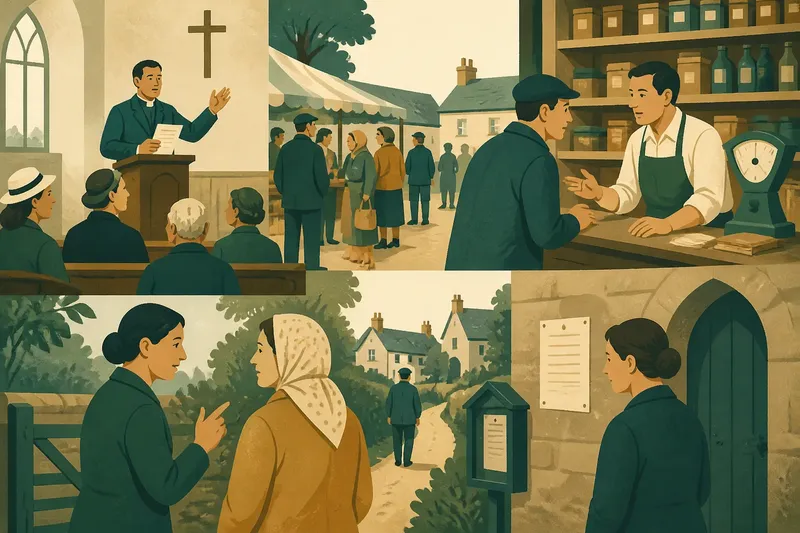
How rural public notices reached people depended on who carried the message and where neighbours gathered. Before noticeboards became familiar, a warning about a road, meeting or public decision might travel through a church service, market, shop counter or spoken relay. These channels left no single, tidy record of who heard what.
What carried news before the noticeboard?
There was no single arrangement shared by every village. Local conditions mattered: the institutions people used, the routes they travelled and the person responsible for passing on a message. A parish officer might send word to a minister or another trusted local figure; that person could announce it to a congregation or pass it to neighbours.
Markets, fairs and other gatherings brought people together, making them natural places for announcements and conversation. Shopkeepers and other people behind counters could also relay information to regular customers. Printed notices might appear on a church door or in another public place, but access depended on knowing where to look and having reason to pass by.
Those routes overlapped rather than forming a universal system. A spoken announcement could carry an explanation, while a written notice offered something that could be checked later. Neither reached everyone simply by being public.
Why did local routines matter?
Information moved along the paths already taken in daily life. Someone who attended a service or visited the village shop might hear news there; someone who worked elsewhere, stayed at home to care for another person or lived on a less-travelled lane might not. The channel shaped the audience before anyone considered the wording.
Word of mouth could be quick and responsive, but each retelling depended on memory and connection. A detail might be lost, or a correction might reach one circle but not another. Print preserved wording, yet a sheet on a church door was of little use to a resident who rarely went there.
Imagine a parish officer asks a shopkeeper to pass on that a meeting has moved from the church room to the school. The shopkeeper tells a regular customer, who tells a neighbour; the second neighbour hears the old venue from someone who missed the first conversation. The likely result is a split message, unless a dated written notice at both buildings provides a clear reference point.
What did gatherings add, and whom did they miss?
A gathering gave people a chance to hear an announcement and ask what it meant. A market or parish meeting could place the message in context, and those present might carry it onwards. That was useful, but attendance was not automatic: distance, timing, work, mobility and caring duties all affected who could be there.
So a gathering was a point of circulation, not proof that a whole community had been informed. The same applied to a church service, even where it was a customary place for announcements. A durable written version gave people who were absent another chance to find the details afterwards.
How did noticeboards change the route?
A noticeboard made public information visible in a fixed place and gave written messages a shared home. Residents could return to it, compare details and see whether a notice had been updated. In that respect, it worked like a town clock: useful as a common reference, but only to people within reach of it.
The board did not replace earlier channels so much as make one of them more dependable. It could not answer questions on its own, and its audience still depended on location, legibility and ordinary routines. A noticeboard at the parish hall might serve people who visited the hall while missing those who did not.
How can the older routes be understood today?
For local historians, parish records, surviving notices and minutes can help establish what formal arrangements existed. They do not necessarily show every informal conversation. A written record may describe an announcement without naming everyone who heard it, so claims about reach need care.
For anyone circulating information now, the historical lesson is practical: do not confuse a public place with a shared route. Use a dated written notice as a record, and pair it with channels people actually encounter. If the message changes, update each version and make the correction visible where the original appeared.
- Check the main posting place: if residents routinely pass it, keep it as the central written record; if not, add a copy at a more-used public venue.
- Check who relies on spoken news: if people use a particular gathering or local intermediary, share the same concise wording there; if the message is complex, provide a written version to consult afterwards.
- Check whether absent residents can learn the details: if work or caring routines keep them away, add a remote channel they already use; if they do not use it, retain a physical copy elsewhere.
- Check whether the notice is current: if its date or status is unclear, replace or mark it; if details have not changed, keep the date visible so readers can judge its currency.
- Check whether readers know what to do next: if the action or contact is missing, add it near the beginning; if it is already clear, preserve that wording across all channels.
- Check whether people receive conflicting versions: if accounts differ, issue one corrected text in every location; if they agree, keep using that shared wording for relays.
The history of how rural public notices reached people is less a story of one invention replacing another than of routes accumulating. A board can preserve the message, a conversation can explain it, and a gathering can let residents question it. The useful final check is whether someone who missed the first announcement can still find the current wording and a clear way to ask what it means.