One Service, Several Ways to Reach It
Compare fixed, mobile and shared rural services to see where each places travel, scheduling and coordination demands, and what to check before relying on one.
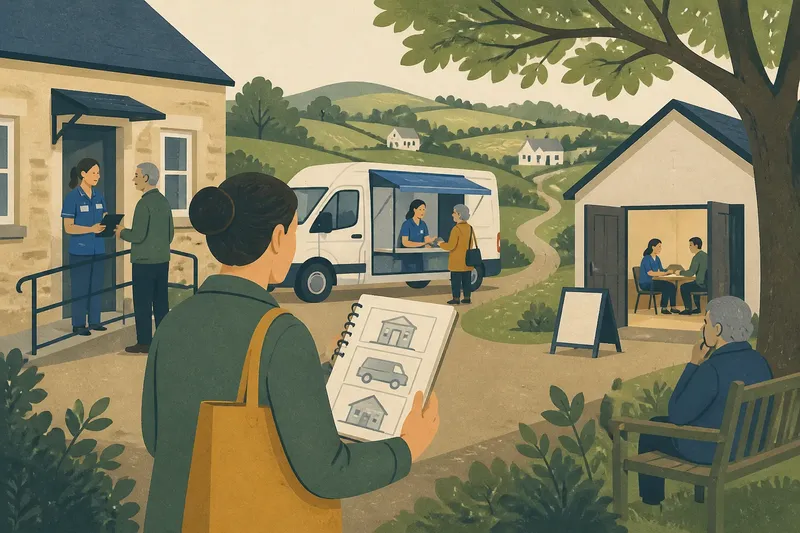
For a rural service, the question is not only where it is delivered, but who has to organise the journey. A fixed clinic, a mobile advice van and a shared village-room session can offer similar help while placing the travel, timing and coordination burden in different hands. Comparing those arrangements is more useful than counting locations on a map.
What does each format ask of the user?
A fixed-location service gives people a known destination and, often, a stable set of opening hours. The user usually arranges the trip: finding transport, allowing for the return journey and fitting the visit around work, caring or school. A permanent address can make referrals and follow-up straightforward, but it does little for someone who cannot reach it.
A mobile service takes its equipment and staff to a sequence of places. That can bring a service closer to people who live far from its base, but its route and visit times become part of the user’s problem. A missed stop may mean waiting for the next visit, and the vehicle may have limited space or facilities compared with a permanent site.
A shared service uses a space already serving another purpose: perhaps a village hall, library room or community hub. It can reduce the need to maintain a dedicated local premises, while depending on room availability, access arrangements and coordination between organisations. The service may be local without being available every day.
Think of the formats as different ways of carrying a shopping basket. A fixed site asks the visitor to carry it all the way; a mobile service brings the basket nearer on a timetable; a shared site sets it down somewhere convenient, provided the room and the people involved are ready.
How should you compare the journey and the timetable?
Start with the whole trip, not the distance between a home and a service point. Consider the journey there and back, the transport options, the time needed inside, and whether an appointment can be missed without losing access for a long stretch. A short drive may still be difficult without a car; a nearby stop may be inconvenient if its visit window conflicts with a bus connection.
Then look at which party controls the schedule. A fixed service may publish regular hours, though appointments can still be scarce or inconvenient. A mobile route has to fit several stops into one circuit, so late running or a changed route can affect more than one community. A shared service may work around the host venue’s calendar, with sessions moving when the room is needed for another activity.
Ask what happens between visits. Can someone make a phone enquiry, submit a form, or arrange follow-up through another local office? Is there a named contact when the van has departed or the shared room is closed? An appealing local session is less useful if a straightforward next question requires another long trip.
What should you ask before choosing a format?
For an individual user, the best arrangement depends on the task and the practical limits of the journey. For a council, service provider or community group choosing how provision should work, the same questions reveal where hidden work is falling. Ask users as well as staff: people who arrange lifts, interpret letters or accompany a neighbour often see burdens that a service timetable does not show.
- Where does the service actually happen? Confirm the address or mobile stop, including whether the venue entrance is accessible and easy to identify.
- How often is it available? Check the published hours or route calendar, and find out how changes are communicated.
- Who arranges transport? Identify whether visitors must make their own way, whether a community transport option is relevant, and what happens if it is unavailable.
- What can be completed at the session? Ask whether staff can deal with the request there or whether the visit is mainly for referral and information.
- How is follow-up handled? Find the contact route for a query, cancellation, missing document or appointment that needs another visit.
- Who coordinates a shared venue? Establish who books the room, opens it, handles signs and tells visitors if the session changes.
These are not demands for every provider to offer every format. They help identify whether a service is accessible in practice, rather than merely present in a building, vehicle route or community calendar.
How can a service plan be checked over a week?
A simple week-long check can expose gaps before a format is treated as settled. On the first day, write down the service task and the person who needs it, without assuming they can travel independently. Note any time constraint, such as a school run, work shift or need for an accompanying person.
On the next working day, check the fixed site’s hours and appointment route, the mobile service’s current schedule and the shared venue’s session information. Use the provider’s own notices or contact channel; an old leaflet on a shop counter is not a reliable timetable. On the third day, trace a realistic outward and return journey for each option, including waiting time and any connection that could be missed.
Say a resident needs help replacing a lost form and cannot leave a relative alone for long. Imagine the fixed office is reachable only with a pre-arranged lift, the mobile van visits during the relative’s regular appointment, and a shared library room has a later drop-in with staff able to issue the form. The useful choice is then the session that fits both the task and the caring constraint, not simply the one closest to the resident’s address.
On the fourth day, contact the likely option and ask what can be completed in one visit and what documents to bring. On the fifth, note the fallback if the session is cancelled or the person cannot attend. At the end of the week, compare the options by practical burden: travel, timing, coordination and the likelihood that a follow-up can be completed without starting again.
Which details do readers often need to clarify?
Is a mobile service always easier to reach?
Not necessarily. It can reduce travel for people near a stop, but its route, limited visit window and onboard facilities may make a particular task harder to complete.
Does a shared venue mean the service is available whenever the building is open?
No. The room may host the service only during booked sessions, and the host organisation’s opening hours may differ from the provider’s. Check the service timetable rather than relying on the building’s general hours.
What if the service requires more than one visit?
Ask whether follow-up can happen by phone, post or through another local office, and who keeps track of the next action. If another in-person visit is required, check its timing before beginning the first one.
Can two formats be used together?
Yes, where providers coordinate them. A mobile session might help with an initial enquiry while a fixed office handles a task needing specialist equipment; the important point is knowing who makes the referral and how the person learns what to do next.
When do local rules and instructions matter?
Some services have eligibility, appointment or document requirements that vary by provider and location. Check the service’s current instructions and, where a formal decision or specialist advice is involved, contact the responsible organisation or a qualified professional. For a shared venue, confirm access and booking arrangements with both the provider and the venue if responsibility is unclear.
For rural services, the most useful comparison is where each format puts the work: on the visitor, the route planner or the people sharing a local space. A fixed address, mobile stop or borrowed room can each be the right arrangement, but only if its timetable and follow-up suit the people expected to use it. Before relying on a service, check one practical detail that maps tend to omit: who will tell you what happens next if the first visit does not finish the task.